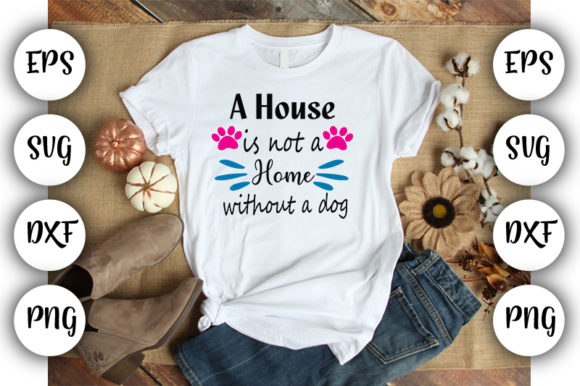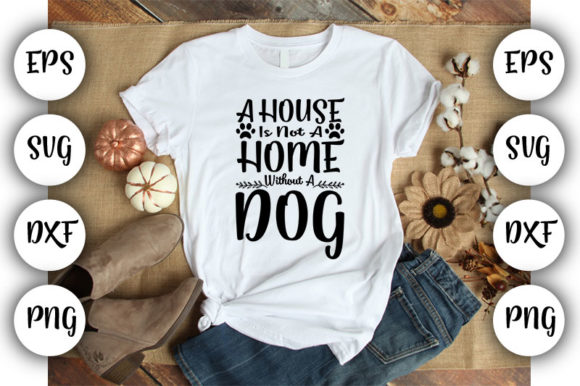
Dog: A House Is Not a Home Without a Dog
As someone who’s stitched thousands of designs across apparel, home goods, and personalized gifts, I opened Dog: A House Is Not a Home Without a Dog expecting warmth—and got it instantly. It’s not cutesy or cluttered; it’s grounded, gently nostalgic, and quietly confident. The house shape is clean but not sterile—slightly rounded eaves, a centered door with subtle detail, and a single dog sitting calmly in front, tail curled just enough to suggest presence, not motion. No exaggerated eyes or cartoonish proportions. Just quiet companionship, rendered in a way that feels handmade even before the needle touches fabric.
This Isn’t Just a T-Shirt Design—It’s a Story You Can Stitch
I tested Dog: A House Is Not a Home Without a Dog on a natural linen tote bag for a local pet-friendly café’s staff gift set. Why a tote? Because it’s unforgiving—loose weave, no stretch, and zero margin for sloppy fill stitch or thread pull. The design held up beautifully: the house outline stayed crisp, the dog’s silhouette read clearly at 4.2 inches wide, and the phrase “A House Is Not a Home Without a Dog” wrapped cleanly beneath in a balanced, medium-weight sans serif. No crowding. No awkward kerning. It felt intentional—not like text pasted on, but part of the composition.
That same balance makes it work across real-world applications: a soft cotton baby onesie (where subtlety reads as tenderness), a structured twill apron (where the house shape anchors the layout), or a loop-woven tea towel (where minimal detail avoids bleeding or fuzzing). It’s equally at home on a relaxed-fit sweatshirt for a rescue fundraiser or stitched into a pillow cover for a vet’s waiting room—never shouting, always resonating.
Where It Shines—and Where You’ll Want to Pause
Dog: A House Is Not a Home Without a Dog excels in medium-to-large embroidery projects: tote bags, pillow covers, sweatshirt fronts, aprons, and nursery wall hangings. Its clean lines translate well to satin stitch borders and smooth fill areas—no micro-detail traps, no fragile stems or tiny windows that vanish under dense stitching. The dog’s form is simplified but expressive: enough curve to read as a resting pup, not a blob. That’s rare in graphics labeled “T-Shirt Designs”—many prioritize screen-print readability over stitch integrity, but this one respects both.
That said, proceed thoughtfully on curved or high-stretch surfaces. A baseball cap front? Possible—but only if you reduce the design to ~3 inches wide and reinforce with cutaway + tearaway stabilizer. The house roofline and lower text baseline need stability to avoid waviness. On thin fabrics like lightweight rayon or baby jersey, use a lightweight fusible backing *under* your main stabilizer—this isn’t a design that forgives shifting layers.
Dark fabrics? It sings there—especially with cream or oatmeal thread. But test contrast first: run a black-and-white mockup to confirm legibility of the dog’s outline against charcoal or navy. And avoid layering it directly over seams or darts without re-hooping; the symmetry matters, and distortion breaks the quiet calm this design relies on.
What This Design Says About Your Craft—and Your Customers
When customers see Dog: A House Is Not a Home Without a Dog on a finished product, they don’t just register “dog + house.” They feel intention. They sense care. That matters—especially for Etsy sellers, boutique owners, and craft fair vendors building trust through authenticity. This isn’t clip-art energy. It carries weight because it’s restrained. That restraint translates to perceived value: buyers pay more for pieces that look designed, not dropped in.
For small shop owners, it’s branding-adjacent without being prescriptive—pair it with neutral tones, kraft packaging, or hand-stamped tags, and it elevates your whole lineup. For holiday embroidery or personalized gifts? It’s emotionally durable. Not tied to a trend or season, it works for birthdays, adoptions, memorials, or “just because” moments. And because it’s offered in SVG, DXF, EPS, and PNG, you can adapt it across mediums: laser-cut wood signs, sublimation prints, or even vinyl decals—without losing fidelity.
Practical Notes from the Hoop
- Always stitch a test on scrap fabric first—especially if using textured weaves or blends. Check how the dog’s ear and tail hold definition.
- Review stitch density before finalizing. Overly dense fills can overwhelm lightweight fabrics; too sparse, and the house shape loses presence.
- Confirm hoop size compatibility. At full scale, this design fits comfortably in a 5x7 hoop—but verify your machine’s max dimensions before loading.
- Inspect small details in your embroidery software: Are the dog’s paws distinct? Does the door handle read as a shape, not a speck?
- Test black-and-white mockups to assess contrast on light vs. dark backgrounds—thread choice changes everything.
- Use appropriate stabilizer: medium-weight cutaway for knits, tear-away for stable wovens, and fused + tear-away for linens or towels.
- Check licensing terms before selling finished embroidered items or reselling the digital embroidery file—this is a Graphics asset, and commercial use rights vary by seller.
In short: Dog: A House Is Not a Home Without a Dog is a quiet performer. It won’t dazzle with complexity—but it delivers clarity, consistency, and emotional resonance, stitch after stitch. Whether you’re prepping for a craft fair, fulfilling an Etsy order, or creating a custom gift for a client who just adopted their first rescue, this design earns its place—not as decoration, but as meaning made tangible.